

Lighting designers traditionally see emergency lighting as a grudge addition to their schemes, but by engaging with the technology rather than leaving it to others they can ensure a better outcome, says Dave Tilley.
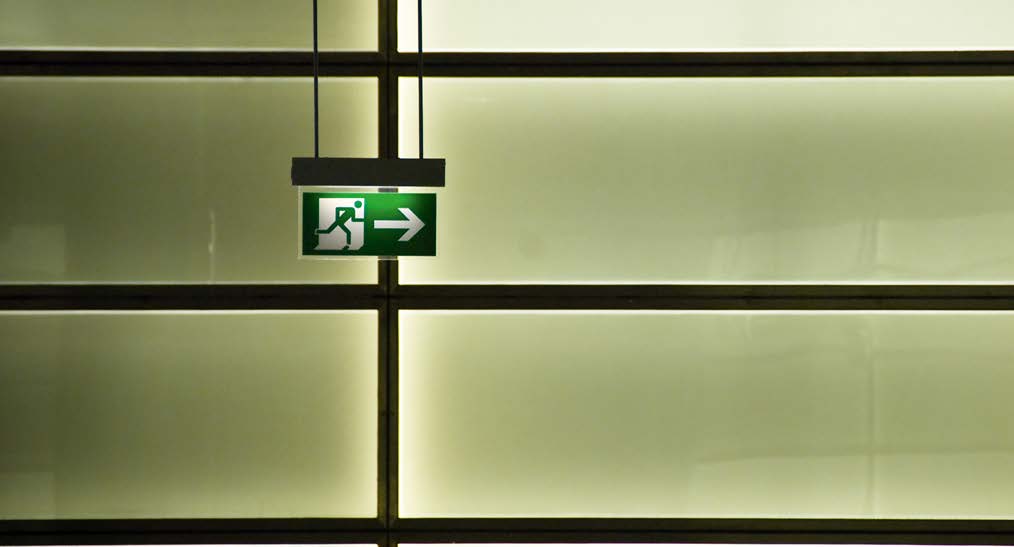
When the lights go out how important is the lighting design, visual impact and client concept when the occupants are trying to leave the affected area safely?
Emergency lighting is not really considered as a primary element of the lighting design process as it does not contribute to the visual appearance and user impact and can often be considered as a distraction to the design features.
A visit to a number of new commercial buildings provides startling evidence relating to the low level of compliance.
In some cases, the emergency lighting does not exist, even in the best cases there are elements of codes such as the British Standard BS5266 that have not been specified and installed, for example points of emphasis not illuminated.
Why not? I believe there are three main reasons.
First, the lighting designer focus is on the primary lighting leaving the emergency lighting to the contractor and may also prescribe restrictions to maintain the impact of their design.
Second, lighting manufacturers provide extremely good emergency lighting designs for main areas but rarely include points of emphasis and special area lighting, particularly large buildings with extended construction timeframes where the building internal structure can change. Lighting manufacturers will say the information is not provided by the client to deliver a fully compliant BS5266, lighting design.
Third, occasionally the emergency lighting element of the design falls between the cracks of, who is responsible for what, and it is simply missed off.
Note that if an emergency lighting design does not provide all the required information, for whatever reason, it should be clearly stated on the design.
The latest Fire Safety Regulations are very clear that responsibility for the emergency lighting design is with all those involved in the process: the client, the designer, the consultant and the contractor.
This means that each group must take responsibility for BS5266. The contractor cannot say the emergency lighting design was installed as instructed by the designer if the design is non-compliant.
Why is the level of emergency lighting system compliance so low in the countries like the UK?
The level of building inspections, especially those targeting emergency lighting, is low which means end-users do not think they will be caught and even if they are the penalties are not often punitive.
Australia has a simple system to support compliance, If the emergency lighting system does not have supportive design and test evidence, insurance companies will not provide building insurance.
Designers, independent and manufacturers, must understand the importance of emergency lighting and accept they are responsible for compliance not just some elements of the design.
They also have to accept that emergency luminaires are designed to provide adequate lux levels and visuals to support escape in the event of a loss of power.
Emergency luminaires have evolved significantly since the introduction of LED, smaller and improved lumens per watt. These improvements reduce the number of emergency luminaires required, to provide compliant minimum lux levels, and luminaire miniaturisation reduces the visual impact on the overall design.
In addition, specialist emergency luminaires have been designed, for example black-body versions for use in cinemas and theatres. Also, there is the option of converting specified luminaires to deliver emergency function.
These innovations in luminaire design enable emergency lighting to blend more easily in the overall design concept, even in historic buildings and those with intricate architectural features.
Lighting designers must take responsibility for the emergency lighting design. If lighting designers want to provide the design concept then responsibility must be taken for the complete design not just a part of it.
While an exit box may look out of place in some spaces, when the lights go out the ability for the occupants to escape safely is paramount.